Atomic Structure
Chapter 06
NoteAudio Summary
Audio created by Google NotebookLM. Note: I have not verified the accuracy of the audio or transcript. Download the transcript here (created by Restream).
Electromagnetic Radiation
Electromagnetic radiation, or light, is a form of energy that is produced by the movement of electrically charged particles through space and was an essential tool to advancing knowledge of the atom. The movement of these particles creates two propagating, orthogonal, oscillating fields - an electric field and a magnetic field, in the form of waves travelling at the speed of light.


Waves are characterized by
- Wavelength (λ) - the distance between two given points on neighboring wave cycles (SI unit: meter)
- Frequency (ν) - the number of waves that pass through a given point in a given amount of time; called hertz (Hz) in cycles or oscillations per second (s–1)
- Amplitude (A) - the maximum height of the wave (SI unit: meter)

The wavelength (λ) and frequency (ν) of a wave are related to the speed (c) at which the wave travels.
\[c = \lambda \nu\]
Notice that wavelength and frequency are inversely proportional (i.e. if wavelength increases, frequency decreases, and vice-versa).
The “two-way” speed of electromagnetic radiation (e.g. light) in a vacuum (c0) is an average speed measured to be
\[\begin{align*} c_0 &= 2.997~924~58 \times 10^{8}~\mathrm{m~s^{-1}} \\[1.5ex] &\approx 2.998 \times 10^{8}~\mathrm{m~s^{-1}} \end{align*}\]
This speed is approximately 186 411 miles per second.
See the Veritasium video on Why No One Has Measured The Speed of Light.
NoteSpeed of light
We will use the speed of light in a vacuum c0 throughout these notes and it will be denoted simply as c with a quantity of 2.998 ×10⁸ m s–1.
Electromagnetic radiation is categorized based on ranges of wavelengths.


Practice
An internet router operates on a 5.0 GHz WiFi network frequency. What is the wavelength (in m) of this light?
Solution
\[\begin{align*} c &= \lambda \nu \longrightarrow \\[1.5ex] \lambda &= \dfrac{c}{\nu} \\[1.5ex] &= \dfrac{2.998\times 10^{8}~\mathrm{m~s^{-1}}} {5.0~\mathrm{GHz} \left ( \dfrac{10^9~\mathrm{Hz}}{\mathrm{GHz}} \right )} \\[1.5ex] &= \dfrac{2.998\times 10^{8}~\mathrm{m~s^{-1}}} {5.0\times 10^{9}~\mathrm{Hz}} \\[1.5ex] &= \dfrac{2.998\times 10^{8}~\mathrm{m~s^{-1}}} {5.0\times 10^{9}~\mathrm{s^{-1}}} \\[1.5ex] &= 0.05\bar{9}96~\mathrm{m} \\[1.5ex] &= 0.060~\mathrm{m} \end{align*}\]
Practice
Amplitude modulation (AM) radio operates in a 540-1 700 kHz frequency range whereas frequency modulation (FM) radio operates in the very high frequency (VHF) range of 87.5-108.0 MHz.
What is the wavelength (in m) of AM radio if tuned to 1 100. kHz and the wavelength (in m) of FM radio if tuned to 105.9 MHz? Which radio frequency has a shorter wavelength?
Solution
AM Radio at 1 100 kHz
\[\begin{align*} c &= \lambda \nu \longrightarrow \\[1.5ex] \lambda &= \dfrac{c}{\nu} \\[1.5ex] &= \dfrac{2.998\times 10^{8}~\mathrm{m~s^{-1}}} {1~100.~\mathrm{kHz} \left ( \dfrac{10^3~\mathrm{Hz}}{\mathrm{kHz}} \right )} \\[1.5ex] &= \dfrac{2.998\times 10^{8}~\mathrm{m~s^{-1}}} {1.10\bar{0}0\times 10^{6}~\mathrm{Hz}} \\[1.5ex] &= \dfrac{2.998\times 10^{8}~\mathrm{m~s^{-1}}} {1.10\bar{0}0\times 10^{6}~\mathrm{s^{-1}}} \\[1.5ex] &= 272.\bar{5}4~\mathrm{m} \\[1.5ex] &= 272.5~\mathrm{m} \end{align*}\]
FM Radio at 105.9 MHz
\[\begin{align*} c &= \lambda \nu \longrightarrow \\[1.5ex] \lambda &= \dfrac{c}{\nu} \\[1.5ex] &= \dfrac{2.998\times 10^{8}~\mathrm{m~s^{-1}}} {105.9~\mathrm{MHz} \left ( \dfrac{10^6~\mathrm{Hz}}{\mathrm{MHz}} \right )} \\[1.5ex] &= \dfrac{2.998\times 10^{8}~\mathrm{m~s^{-1}}} {1.05\bar{9}0\times 10^{8}~\mathrm{Hz}} \\[1.5ex] &= \dfrac{2.998\times 10^{8}~\mathrm{m~s^{-1}}} {1.05\bar{9}0\times 10^{8}~\mathrm{s^{-1}}} \\[1.5ex] &= 2.83\bar{0}9~\mathrm{m} \\[1.5ex] &= 2.831~\mathrm{m} \end{align*}\]
FM radio has a shorter wavelength.
Quantization of Light
Light is a form of energy. The amount of energy that a particular wave of light has is quantized meaning that light exists as “discrete packets” of energy rather than energy being continuous. These “packets of energy” are called photons (massless particles) and each photon carries a specific amount of energy. More intense light (brighter light), results from an increasing number of photons of light.
See Ted Ed talk entitled Light waves, visible and invisible by Lucianne Walkowicz.
Background: Light as Explained by Classical Physics
Let us briefly review light as explained by classical physics where light was only thought of as a continuous wave and not as a photon.
The “brightness” of light is a perceived property of light. According to classical physics, the brightness of light is directly proportional to the intensity (I in W m–2) of the light.
\[\mathrm{brightness} \propto I\]
Light intensity is power per unit area and is a measure of how much energy per unit time (i.e. power, P, in Watts, W; also J s–1) from light hits a surface of a given area (A).
\[I = \dfrac{P}{A}\]
Note: Light intensity is related to the electric field amplitude (E0 in m) of light. Specifically, intensity is proportional to the square of the electric field amplitude (E02) where E02 is area. Therefore, a wave is “stronger” at larger amplitude.
\[I \propto E_0^2\]
Therefore, the perceived brightness of light increases with
- increasing intensity (the amount of power, or energy a light wave carries per unit time, that hits a defined area)
- increasing power (the amount of energy light carries per unit time)
- increasing light amplitude (where amplitude is the maximum “strength” of the oscillating electric and magnetic fields in a light wave)
Example
If the amplitude of a light wave is doubled (by increasing the power of light), the intensity of the light increases by a factor of 22 = 4. A small increase in light amplitude leads to an exponential increase in intensity.
Finally, light intensity is related to spectral radiance (L(λ)) where spectral radiance is the amount of radiant energy emitted by a black body at a certain temperature for a specific wavelength (λ). At large wavelength, the spectral radiance is low. As wavelength decreases, spectral radiance increases to a maximum (λmax) and then begins to decrease. The peak of spectral radiance increases with increasing temperature.
Planck and the Ultraviolet Catastrophe
In the late 19th century, classical physics, using the laws of thermodynamics and electromagnetism, predicted that the intensity of electromagnetic radiation emitted by a black body at thermal equilibrium would increase without limit as the wavelength of light decreased.
Black-body radiation
A “black body” in physics is a physical body that absorbs all electromagnetic radiation. The radiation emitted by a black body at a specfic temperature is called black-body radiation. In contrast, a “white body” is a body that reflects all electromagnetic radiation.
A black body emits a signature spectral density, a relationship between power/intensity of light over a range of wavelengths or frequencies, and is related to its emission spectrum, a plot that shows the power/intensity of light across a set of wavelengths or frequencies that are emitted by an object.

When a black body is heated, it begins to give off radiation. We can see some of this radiation if the light emitted includes visible light. As the black body gets hotter, the color shifts from red, to orange, to blue. Notice how λmax (the peak of each curve) increases with increasing temperature.
The emitted radiation of a heated black body comes from the oscillations of charged particles (such as electrons; called “oscillators”) in an electric field that make up the black body. These particles oscillate (or vibrate) with increasing temperature meaning that the kinetic energy of the vibrations also increase with temperature. The faster they vibrate, the radiation that is emitted increases.
Classical physics assumed that the vibrations could vibrate at all possible frequencies and the energy radiated at each frequency was proportional to the frequency itself. This led to the prediction that at high frequencies (such as UV light and beyond), the energy radiated should increase without limit. However, experimental data clearly showed that the energy reaches a peak and decreases to zero.
Simulate black-body radiation curves
Emission spectra of different forms of light

This unbounded behavior of energy was described by the Rayleigh-Jeans law that demonstrates the relationship of spectral radiance (Lλ if defined in terms of wavelength) to be inversely proportional to the wavelength of light from a black body at a given temperature.
\[L(\lambda) \propto \dfrac{1}{\lambda^4}\]
Rayleigh-Jeans law
The Rayleigh-Jeans law for a given wavelength (λ) as a function of temperature (T) is written as
\[L(\lambda, T) = \dfrac{2ck_{\mathrm{B}}T}{\lambda^4}\]
where
- L(λ) is the spectral radiance (power emitted per unit emitting area, per steradian, per unit wavelength)
- c is the speed of light
- kB is the Boltzmann constant
- T is temperature (in K)
Spectral radiance increases linearly with increasing temperature and increases quartically decreasing wavelength.
The Boltzmann constant (kB) provides a bridge between temperature and energy in statistical mechanics and thermodynamics. It relates the average energy of particles in a system to the system’s temperature expressed as
\[E_{\mathrm{avg}} = \dfrac{3}{2}k_{\mathrm{B}}T\]
The Boltzmann constant is expressed in J K–1 and defined as
\[k_{\mathrm{B}} = 1.380~649 \times 10^{-23}\]
This relationship shows that as the wavelength of light decreases, the spectral radiance of light increases quartically (as a power of 4) without bound. This description of light implied that an infinite amount of energy (area under the spectral radiance curve) would be emitted in the ultraviolet region of the electromagnetic spectrum which is impossible. Experimental observations showed that energy emitted does not increase indefinitely, but rather reaches a peak (λmax) and then decreases at shorter wavelengths.
The black line in the figure below shows how, according to classical physics, the spectral radiance of light grows to infinity as the wavelength of light approaches the UV region of the electromagnetic spectrum. Note that the Rayleigh-Jeans law (black line) “did okay” with describing the energy distribution of black body radiation at longer wavelengths but completely failed at shorter wavelengths.


Max Planck, a German physicist, solved the catastrophe (in 1900) that classical physics proposed. Planck’s solution is referred to as Planck’s Law which imposed a limit on how energy is emitted at different wavelengths, particularly at short wavelengths (high frequencies). This equation correctly described the spectral distribution of black-body radiation at all wavelengths. Planck hypothesized that energy could not be emitted continuously as classical physics suggested, rather, energy had to be emitted in discrete packets called quanta.
Planck’s law
Planck’s Law can be expressed in many different ways. Written as a function of wavelength and temperature gives
\[L(\lambda, T) = \dfrac{2hc^2}{\lambda^5} \left ( \dfrac{1}{e^{\frac{hc}{\left(\lambda k_{\mathrm{B}}T\right )}} - 1}\right )\] Similarity to Rayleigh-Jeans law at long wavelength
At long wavelengths (λ), the exponential term in Planck’s law approaches 1. This term can then be approximated using the Taylor expansion
\[e^x \approx 1 + x\] giving
\[e^{\dfrac{hc}{\lambda k_{\mathrm{B}}T}} \approx 1 + \dfrac{hc}{\lambda k_{\mathrm{B}}T}\]
Substituting this approximation, at long wavelenghts, into Planck’s law gives
\[L(\lambda, T) = \dfrac{2hc^2}{\lambda^5} \left ( \dfrac{1}{\left ( 1 + \dfrac{hc}{\lambda k_{\mathrm{B}}T} \right ) - 1}\right )\]
Simplifying, the 1 terms cancel out
\[\begin{align*} L_{\mathrm{\lambda}}(\lambda, T) &= \dfrac{2hc^2}{\lambda^5} \left ( \dfrac{1}{\left ( \dfrac{hc}{\lambda k_{\mathrm{B}}T} \right )}\right ) \\[1.5ex] &= \dfrac{2ck_{\mathrm{B}}T}{\lambda^4} \end{align*}\]
which agrees with the Rayleigh-Jeans law (at long wavelength) given as
\[L(\lambda, T) = \dfrac{2ck_{\mathrm{B}}T}{\lambda^4}\]
Behavior at short wavelength
At shorter wavelength (high frequency), the exponential term in Planck’s Law becomes large (much greater than 1).
\[e^{\dfrac{hc}{\lambda k_{\mathrm{B}}T}} >\!> 1\]
Thus, the denominator term is approximately equal to the exponential term.
\[e^{\dfrac{hc}{\lambda k_{\mathrm{B}}T}} -1 ~~\approx~~ e^{\dfrac{hc}{\lambda k_{\mathrm{B}}T}}\]
Planck’s Law simplifies to
\[L(\lambda, T) = \dfrac{2hc^2}{\lambda^5} \left ( \dfrac{1}{e^{\frac{hc}{\left(\lambda k_{\mathrm{B}}T\right )}}}\right )\]
As wavelength continues to decrease, the exponential term grows exponentially, causing the spectral radiance to decrease exponentially. Planck’s Law imposed a bound on spectral radiance at short wavelength whereas the Rayleigh-Jeans law did not correctly describe this behavior.


Planck proposed that the oscillations in a black body can only emit or absorb energy in discrete packets (quanta), where the energy of each packet ( E ) is proportional to the frequency ( ν ) of the vibration via a proportionality constant called Planck’s constant (h in J s). This relationship is called Planck’s Equation given in terms of frequency or wavelength, respectively, as
\[E = h\nu = \dfrac{hc}{\lambda}\]
At higher frequency, the energy packet becomes larger. Therefore, higher frequency oscillations need to emit or absorb large packets of energy in order to vibrate at that frequency. However, at typical thermal energies, there is not enough available energy to excite many high-frequency oscillators. Therefore, the probability of oscillating at higher frequencies drops off sharply as the energy required to do so increase.
Typical thermal energies
Room Temperature (~300 K)
\[E_{\mathrm{thermal}} \approx k_{\mathrm{B}} \times 300~\mathrm{K} = 4.14\times 10^{-21}~\mathrm{J} ~~~(\mathrm{or~0.025~eV})\] Boiling Point of Water (~373 K)
\[E_{\mathrm{thermal}} \approx k_{\mathrm{B}} \times 373~\mathrm{K} = 5.17\times 10^{-21}~\mathrm{J} ~~~(\mathrm{or~0.032~eV})\]
Sun’s Surface Temperature (~5800 K)
\[E_{\mathrm{thermal}} \approx k_{\mathrm{B}} \times 300~\mathrm{K} = 8.00\times 10^{-20}~\mathrm{J} ~~~(\mathrm{or~0.5~eV})\]
Note: The electronvolt (also written as electron-volt or electron volt), is a measure of the kinetic energy gained by a single electron accelerating through an electric potential difference of one volt in a vacuum. The eV is related to the Joule given as
\[1~\mathrm{eV} = 1.60218\times 10^{-19}~\mathrm{J}\]
At room temperature, the available thermal energy is about 0.025 eV. This amount of energy is enough to excited oscillators emitting infrared radiation (longer wavelengths, lower frequencies), but not enough to excite oscillators that would emit UV radiation because UV photons require much more energy (several electron volts).
Planck’s law contains this new constant, h, a value that was obtained empirically by fitting his equation (Planck’s law) to experimental data. Planck determined the value of h that gave the best match. Coincidentally, Planck’s constant is now a fundamental physical constant and is given as
\[\begin{align*} h &= 6.626~070~15 \times 10^{-34}~\mathrm{J~s} \\[1.5ex] &\approx 6.626\times 10^{-34}~\mathrm{J~s} \end{align*}\]
Practice
Amplitude modulation (AM) radio at 1 100 kHz frequency has a wavelength of 272.5 m and frequency modulation (FM) radio at 105.9 MHz frequency has a wavelength of 2.831 m.
What is the energy (in electronvolts, eV) of these two waves?
\[1~\mathrm{eV} = 1.602~18\times 10^{-19}~\mathrm{J}\]
Solution
Recall that wavelength and frequency are related through the speed of light.
\[c = \lambda \nu\]
AM Radio at 1 100 kHz
\[\begin{align*} E &= h\nu \\[1.5ex] &= h \left ( \dfrac{c}{\lambda} \right ) \\[1.5ex] &= 6.626\times 10^{-34}~\mathrm{J~s} \left ( \dfrac{2.998\times 10^{8}~\mathrm{m~s^{-1}}}{272.5~\mathrm{m}} \right ) \left ( \dfrac{1~\mathrm{eV}}{1.60218\times 10^{-19}~\mathrm{J}} \right ) \\[1.5ex] &= 4.54\bar{9}9\times 10^{-9}~\mathrm{eV} \\[1.5ex] &= 4.550\times 10^{-9}~\mathrm{eV} \\[1.5ex] \end{align*}\]
FM Radio at 105.9 MHz
\[\begin{align*} E &= h\nu \\[1.5ex] &= h \left ( \dfrac{c}{\lambda} \right ) \\[1.5ex] &= 6.626\times 10^{-34}~\mathrm{J~s} \left ( \dfrac{2.998\times 10^{8}~\mathrm{m~s^{-1}}}{2.831~\mathrm{m}} \right ) \left ( \dfrac{1~\mathrm{eV}}{1.60218\times 10^{-19}~\mathrm{J}} \right ) \\[1.5ex] &= 4.37\bar{9}5\times 10^{-7}~\mathrm{eV} \\[1.5ex] &= 4.380\times 10^{-7}~\mathrm{eV} \end{align*}\]
FM radio has a shorter wavelength.
Photoelectric Effect
The photoelectric effect is the emission of electrons from a material caused by electromagnetic radiation. This phenomenon was explored by Albert Einstein, an German-born physicist, in 1905, for which he won the Nobel Prize in Physics in 1921.
Shining light on a metal surface can cause electrons to be ejected from the metal.


Light at low frequency (below the threshold frequency for a given material) did not eject any electrons. However, if the frequency of light was increased enough (past the threshold frequency), electrons were ejected immediately without a time delay. The more intense the light, the more electrons were ejected.

The maximum velocity (vmax) of the ejected electron is related to the kinetic energy of the ejected electron (Telectron). This kinetic energy is calculated as the difference in energy of the electron (Ephoton) and the work function (φ) of a material (i.e. the minimum thermodynamic work, or energy, needed to remove an electron from a solid to a point in a vacuum).
\[T_{\mathrm{electron}} = E_{\mathrm{photon}} - \phi\]
Practice
What is the velocity (in m s–1) of an electron that is ejected from the surface of a metal by 550.0 nm light? The work function of the metal is φ = 2.00 eV.
Solution
Find the energy (in J) of the photon
\[\begin{align*} E_{\mathrm{photon}} &= \dfrac{hc}{\lambda} \\[1.5ex] &= \dfrac{6.626\times 10^{-34}~\mathrm{J~s} \left ( 2.998\times 10^{8}~\mathrm{m~s^{-1}} \right )} {550.0~\mathrm{nm} \left ( \dfrac{\mathrm{m}}{10^9~\mathrm{nm}} \right )} \\[1.5ex] &= 3.61\bar{1}7\times 10^{-19}~\mathrm{J} \end{align*}\]
Find the kinetic energy (in J) of the ejected electron
\[\begin{align*} T_{\mathrm{electron}} &= E_{\mathrm{photon}} - \phi \\[1.5ex] &= 3.61\bar{1}7\times 10^{-19}~\mathrm{J} - \left [ 2.00~\mathrm{eV} \left ( \dfrac{1.602~08\times 10^{-19}~\mathrm{J}}{\mathrm{eV}} \right )\right ] \\[1.5ex] &= 4.0\bar{7}5\times 10^{-20}~\mathrm{J} \end{align*}\]
Find the velocity (in m s–1) of the electron
Recall that the mass of an electron, me, is 9.109 383 7 × 10–31 kg.
\[\begin{align*} T &= \dfrac{1}{2}mv^2 \longrightarrow \\[1.5ex] v &= \sqrt{\dfrac{2T}{m_e}} \\[1.5ex] &= \sqrt{\dfrac{2~(4.0\bar{7}5\times 10^{-20}~\mathrm{J})} {9.109~383~7~\times 10^{-31}~\mathrm{kg}}} \\[1.5ex] &= 2.9\bar{9}1\times 10^{5}~\mathrm{m~s^{-1}} \\[1.5ex] &= 2.99\times 10^{5}~\mathrm{m~s^{-1}} \end{align*}\]
Classical physics predicted that the intensity of a light (i.e. the amount of energy delivered per second) would have been the deciding factor in ejecting an electron. It was presumed that light would impact the surface of the metal and the electrons would be able to “absorb” or “build up” enough energy over time before finally being ejected since light (viewed as a continuous electromagnetic wave) was thought to deliver energy in a continuous manner.
TipAn analogy
Imagine throwing popcorn at a cue ball on a pool table. It didn’t matter if you threw one, two, or 500 individual pieces of popcorn sequentially at the pool ball… the ball will not move (the pool ball wont “store up” the energy from each individual hit and eventually move).
However, if you threw the popcorn really, really fast (fast enough), it could move the cue ball.
However, the experimental observations demonstrated that it was the frequency (and hence, energy) of the light that dictated the ejection of an electron as well as the electron’s kinetic energy. A frequency at or beyond the threshold frequency resulted in an ejection of electrons. Increasing light intensity at or beyond the threshold frequency resulted in more electrons being ejected.
There was no “build up” of energy that resulted in the ejection of an electron. The energy transfer process was “all-or-nothing”. This meant that light behaved, not as a continuous wave, but as a stream of discrete packets of energy called photons (where more photons equates to higher intensity). Either the electron absorbed all of a photon’s energy (to be ejected) or it didn’t absorb it at all. Each photon carries a specific amount of energy and that energy had to be large enough to free an electron from the material. If the energy of the photon was too low (low frequency), no ejection is observed, regardless of the intensity of the light.
If the photon did not have enough energy to eject an electron, the energy of the photon is either (1) reflected, (2) absorbed by the material leading to a small increase in thermal energy, or (3) scattered.
This discovery led to the concept of wave-particle duality, which states that light exhibits both wave-like (from classical physics) and particle-like (from quantum physics) properties. One key experiment that demonstrates the two behaviors of light is the double-slit experiment.
Atomic Line Spectra
Atoms of a particular element in the gas phase, when exposed to high voltage, emit specific, intense wavelengths of light (specific colors if in the visible region) where each wavelength of light corresponds to a specific amount of energy emitted. Each type of element has a characteristic line emission spectrum made up of spectral lines and provides a type of “fingerprint” of the element.

Where do these “lines”, or specific wavelengths, come from?
Recall that the movement of charged particles (such as an electron) in an electric field (such as in a black body radiator) generates an emission of light. Atoms also emit light when energized with high voltage. Therefore, the movement of electrons in an atom give rise to the characteristic wavelengths of light for a given element. Since each element has a specific set of intense wavelengths, the movement of electrons within these elements are also unique to the element.
This concept led to the Bohr Model of the atom where electrons were thought to reside in certain energy levels, n, in specific “orbits” around the nucleus.


Here, an electron (green dot) resides in the n = 3 energy level (or orbit) of the hydrogen atom. When it transitions (i.e. moves) to a lower energy level (here, n = 2; referred to as a 3 → 2 electronic transition), the electron loses energy and the energy ( ΔE ) is released in the form of light (hν). This transition is an example of an atom in an excited state that relaxes into a lower energy state (the lowest energy state is called the ground state of an atom). The spacing of these energy levels are unique to the element and the spacings decrease between levels of higher energy.

Johann Balmer and Johannes Rydberg worked on this problem and tried to characterize the atomic line spectrum of the hydrogen atom mathematically leading to the Balmer equation given as
\[\dfrac{1}{\lambda} = R_{\mathrm{H}} \left ( \dfrac{1}{2^2} - \dfrac{1}{n^2} \right ) ~~~~~\mathrm{for~n = 3, 4, 5\ldots}\]
where λ is the wavelength of the emitted/absorbed light, RH is the Rydberg constant for hydrogen (RH = 1.0974 ×10⁷ m–1), and n is a single integral constant greater than 2. The four visible wavelengths of the hydrogen atom emission spectrum is now known as the Balmer series.


Other electronic transitions within the hydrogen atom ( hydrogen spectral series ) were further characterized and include the Lyman series and the Ritz-Pachen series, among others.
- Lyman series - transitions from n > 1 to n = 1 energy level
- Balmer series - transitions from n > 2 to n = 2 energy level
- Ritz-Paschen series - transitions from n > 3 to n = 3 energy level


The energy of an electron in the nth level (En) in the hydrogen atom is given as
\[E_n = -\dfrac{R_{\mathrm{H}}hc}{n^2}\]
where RH is the Rydberg constant for the hydrogen atom (RH = 1.0974 ×10⁷ m–1), h is Planck’s constant, c is the speed of light, and n is the energy level.
The energy change associated with an electronic transition in the hydrogen atom can be determined by taking the difference of the final and initial energies of the electron such that
\[\begin{align*} \Delta E &= E_{\mathrm{final}} - E_{\mathrm{initial}} \\[1.5ex] &= -\dfrac{R_{\mathrm{H}}hc}{n_{\mathrm{final}}^2} + \dfrac{R_{\mathrm{H}}hc}{n_{\mathrm{initial}}^2} \\[1.5ex] &= -R_{\mathrm{H}}hc \left ( \dfrac{1}{n_{\mathrm{final}}^2} - \dfrac{1}{n_{\mathrm{initial}}^2} \right ) \\[1.5ex] &= -\mathrm{Ry} \left ( \dfrac{1}{n_{\mathrm{final}}^2} - \dfrac{1}{n_{\mathrm{initial}}^2} \right ) \end{align*}\]
where Ry is the Rydberg unit of energy defined as
\[\begin{align*} 1~\mathrm{Ry} \equiv R_{\mathrm{H}}hc &= 2.179~872~361~103~0(24) \times 10^{-18}~\mathrm{J} \\[1.5ex] &\approx 2.18\times 10^{-18}~\mathrm{J} \end{align*}\]
Practice
Determine the energy (in J) of an electron in the n = 3 energy level as well as the n = 2 energy level of a single hydrogen atom.
Determine the energy change (ΔE in J) of the electron as well as the wavelength (in nm) of light produced when a 3 → 2 electronic transition occurs.
Solution
Energy for n = 3
\[\begin{align*} E_3 &= -\dfrac{R_{\mathrm{H}}hc}{n^2} \\[1.5ex] &= -\dfrac{(1.0974 \times 10^{7}~\mathrm{m^{-1}}) (6.626\times 10^{-34}~\mathrm{J~s}) (2.998\times 10^{8}~\mathrm{m~s^{-1}})} {3^2} \\[1.5ex] &= -2.42\bar{2}1 \times 10^{-19}~\mathrm{J} \\[1.5ex] &= -2.422 \times 10^{-19}~\mathrm{J} \end{align*}\]
Energy for n = 2
\[\begin{align*} E_2 &= -\dfrac{R_{\mathrm{H}}hc}{n^2} \\[1.5ex] &= -\dfrac{(1.0974 \times 10^{7}~\mathrm{m^{-1}}) (6.626\times 10^{-34}~\mathrm{J~s}) (2.998\times 10^{8}~\mathrm{m~s^{-1}})} {2^2} \\[1.5ex] &= -5.44\bar{9}8 \times 10^{-19}~\mathrm{J} \\[1.5ex] &= -5.450 \times 10^{-19}~\mathrm{J} \end{align*}\]
Notice how the energy n = 2 is lower than the energy at n = 3.
Energy change of electron
\[\begin{align*} \Delta E &= E_3 - E_2 \\[1.5ex] &= (-5.44\bar{9}8 \times 10^{-19} - -2.42\bar{2}1 \times 10^{-19})~\mathrm{J} \\[1.5ex] &= -3.02\bar{7}8 \times 10^{-19}~\mathrm{J} \\[1.5ex] &= -3.028 \times 10^{-19}~\mathrm{J} \end{align*}\]
The electron is relaxing (losing energy) from the n = 3 energy level down to the n = 2 energy level.
Energy of photon
The electron lost energy (–3.028 ×10⁻¹⁹ J). The energy released (in the form of a photon) is the opposite in sign (3.028 ×10⁻¹⁹ J).
Wavelength of light
Here, the energy of the light ( E ) is equal to (but opposite in sign) to the change in energy ( ΔE ) of the electron undergoing relaxation.
\[\begin{align*} E &= \dfrac{hc}{\lambda} \longrightarrow \\[1.5ex] \lambda &= \dfrac{hc}{E} \\[1.5ex] &= \dfrac{(6.626\times 10^{-34}~\mathrm{J~s}) (2.998\times 10^{8}~\mathrm{m~s^{-1}})} {3.02\bar{7}8 \times 10^{-19}~\mathrm{J}} \left ( \dfrac{10^9~\mathrm{nm}}{\mathrm{m}} \right ) \\[1.5ex] &= 656.\bar{0}7~\mathrm{nm} \\[1.5ex] &= 656.1~\mathrm{nm} \end{align*}\]
656 nm light is the red light that appears in the hydrogen emission spectrum.
Wave-Particle Duality
Watch: Dr. Quantum’s Double-Slit Experiment video.
Watch: Space Time (by PBS) The Quantum Experiment that Broke Reality video.
If light can exhibit wave- and particle-like properties, can matter exhibit wave properties as well?
Louius Victor de Broglie proposed that a free electron with mass (m) and velocity (v) should have a corresponding wavelength (λ) given as
\[\lambda = \dfrac{h}{mv}\]
Here, wavelength decreases with increasing mass. At sufficiently large mass and volume, the associated wavelength is too small to measure, rendering the concept of wavelength for macroscopic objects meaningless.
Modern Electronic Structure and Quantum Mechanics
The Bohr model (particle treatment of the electron) was quickly replaced when Erwin Schrödinger developed a model for electrons that could represent matter (such as electrons) as (standing) waves.
These scientific discoveries and advances made by pioneers like Planck, Einstein, Schrödinger, and many others led to a revolution in physics that birthed an entire new field of study called quantum mechanics, a fundamental theory that describes nature at and below the scale of atoms.
Standing Waves
Standing waves are stationary waves that oscillates with time with a peak amplitude profile does not move through space. Points on the wave that do not move at all (where the amplitude is always zero) are called nodes.


Only certain wavelengths of the wave are allowed and dependent upon the length of the string. The wavelength of these standing waves are restricted to
\[\lambda = \dfrac{nL}{2} ~~~\mathrm{where~n} = 1,2,3\ldots\]
where λ is the wavelength and L is the length of the wave.

If the wave was confined to a circle, the wave could only have certain integral wavelengths to fit the circumference of the circle such that
\[2\pi r = n\lambda, ~~~n = 1,2,3,\ldots\]

Erwin Schrödinger developed the Schrödinger equation that correctly described the wave-like nature of matter.
\[\hat{H}\Psi = E\Psi\]
A wavefunction (Ψ in the Schrödinger equation) describes the behavior of these matter waves. Only certain wavefunctions correctly describe an electron in an atom and the associated energy (E) can be determined using an operator ( such as the Hamiltonian, Ĥ ). Therefore, the Schrödinger equation properly accounts for the quantization of energy of an electron.
Solutions to the Schrödinger equation properly describe an electron in three-dimensional space and includes the quantum numbers n, l, and ml in the non-relativistic equation while ms is also included in the relativistic form of the equation.
Additionally, taking the square of the wavefunction gives a probability density which gives the probability of finding an electron at a given position.

The amplitude of the probability density (Ψ2) indicates the most probable position of an electron with an energy corresponding to Ψ.
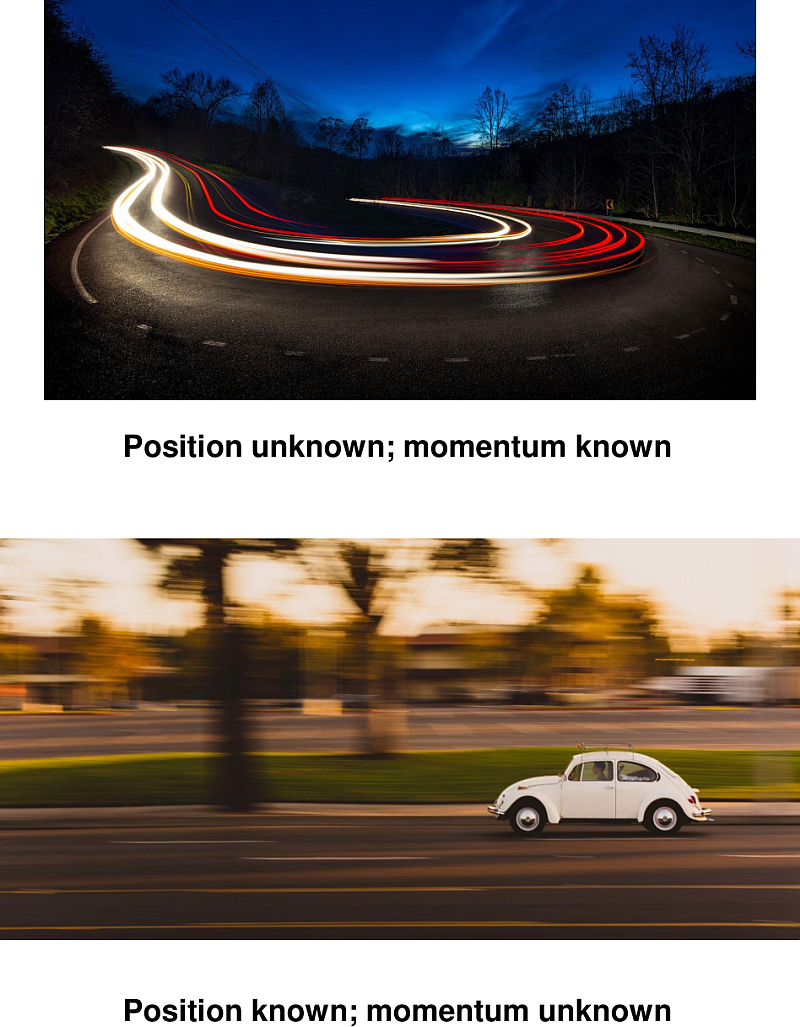
Finally, in Bohr’s model of the atom, both the location (orbit) and energy of an electron in the hydrogen atom are described simultaneously with accuracy. However, quantum mechanics demonstrates that it is impossible to know both the change in position (Δx) and change in momentum (Δp) of very small particles. This is called the uncertainty principle or Heisenberg’s indeterminancy principle given as
\[\Delta x \Delta p \ge \dfrac{\hbar}{2}\]
where ℏ is the reduced Planck’s constant with a value of 1.054 571 817… ×10–34 J s. In other words, the more you know a particle’s position, the less you know about it’s momentum, and vice-versa. The more you know where a particle is, the less you know how fast it is going.
Imagine taking a picture of a fast moving car. If the shutter speed of the camera is fast enough, you could capture an image that would make the car look like it was stationary. That image would give you virtually no information about how fast the car was moving.
Quantum Numbers
The positions of electrons in an atom as well as their energies are described by their wavefunctions. This leads to atomic orbitals, regions of space where electrons are likely to be found (i.e. an electron’s probability density). These orbitals have specific energies and shapes. Only two electrons can be in located in any given atomic orbital.
The quantum numbers are a set of numbers (n, l, ml, ms) that fully characterize the possible states of a system, or the state of an electron in the hydrogen atom (or hydrogen-like atom; a particle with one electron).
Principle quantum number, n
The principle quantum number, n, indicates the orbital size. Electrons in atoms reside in atomic orbitals. These are referred to s, p, d, f, … type orbitals. A 1s orbital is smaller than a 2s orbital. A 2p orbital is smaller than a 3p orbital. This is because orbitals with larger n values are getting larger due to the fact that they are further away from the nucleus. The principle quantum number is an integer value (> 0) where
\[n = 1, ~2, ~3, \ldots\]
The principle quantum number describes the describes the electron shell (or energy level) of an electron. An electron shell can be thought of as an orbit that an electron follows around an atom’s nucleus. An electron with a quantum number of n = 1 is said to reside in the first electron shell (or first energy level).
Azimuthal quantum number, l
The azimuthal quantum number (or orbital angular momentum quantum number), l, describes the shape of the orbital (called a subshell) that an electron resides in. l is an integer between 0 and n - 1.
\[l = 0, ~1, ~2, ~3, \ldots, ~n-1\]
Therefore, if n = 2 for an electron, l can be 0 or 1 for that electron. Subshells have a specific shape and a letter (or label) is associated with different values for l.
Orbitals with l = 0 are called s orbitals; orbitals with l = 1 are called p orbitals, and so on.
s-type orbitals are spherical in shape while p-type orbitals have a “dumbbell” like shape.
Magnetic quantum number, ml
The magnetic quantum number, ml, indicates the orientation in space of the orbital within a subshell. Electrons in a given orientation of a particular subshell have the same energy. The magnetic quantum number can have positive and negative values that span from –l to l.
\[m_{\mathrm{l}} = 0, \pm 1, \pm 2, \ldots, \pm l\]
There are 2l+1 values of ml for a given subshell, l. For example, an electron with a value of l = 1 can have one of three values for ml (–1, 0, 1). That is, an electron in a p orbital can reside in one of the three orientations of that p orbital of shell n.
Note: There is no specific assignment of ml to a particular orientation (we do not assign ml to, say, a px orbital).
Spin quantum number, ms
The spin quantum number, ms, indicates the “spin” of an electron. Thus far we have introduced three quantum numbers that localize a position to an orbital of a particular size, shape and orientation. We now introduce the fourth quantum number that describes the type of electron that can be in that orbital. Recall that two electrons can reside inside one atomic orbital.
We can define each one uniquely by indicating the electron’s spin. According to the Pauli-exclusion principle, no two electrons can have the exact same four quantum numbers. This means that two electrons in one atomic orbital cannot have the same “spin”. We generally denote “spin-up” as ms = 1/2 and spin-down as ms = –1/2.
\[m_{\mathrm{s}} = \dfrac{1}{2} ~~\mathrm{or}~~ -\dfrac{1}{2}\]
While it is easy to rationalize the spin of an electron as a “spinning planet” (classical spin), where a counter-clockwise rotation results in a “spin-up” designation while a clockwise rotation results in a “spin-down”, this is not reality. Electrons in atoms are waves and do not behave as a spinning planet. They have a “quantum spin”. Nevertheless, the property of spin arises from experimental observations such as the Stern-Gerlach experiment.
TipWhat do the quantum numbers actually signify?
Quantum numbers give information about the location of an electron or set of electrons. A full set of quantum numbers describes a unique electron for a particular atom.
Think about it as the mailing address to your house. It allows one to pinpoint your exact location out of a set of n locations you could possibly be in. We can narrow the scope of this analogy even further. Consider your daily routine. You may begin your day at your home address but if you have an office job, you can be found at a different address during the work week. Therefore we could say that you can be found in either of these locations depending on the time of day. The same goes for electrons. Electrons reside in atomic orbitals (which are very well defined ‘locations’). When an atom is in the ground state, these electrons will reside in the lowest energy orbitals possible (e.g. 1s2, 2s2, and 2p2 for carbon). We can write out the physical ‘address’ of these electrons in a ground-state configuration using quantum numbers as well as the location(s) of these electrons when in some non-ground (i.e. excited) state.
You could describe your home location any number of ways (GPS coordinates, qualitatively describing your surroundings, etc.) but we’ve adapted to a particular formalism in how we describe it (at least in the case of mailing addresses). The quantum numbers have been laid out in the same way. We could communicate with each other that an electron is “located in the lowest energy, spherical atomic orbital” but it is much easier to say a spin-up electron in the 1s orbital instead. The four quantum numbers allows us to communicate this information numerically without any need for a wordy description.
Of course carbon is not always going to be in the ground state. Given a wavelength of light for example, one can excite carbon in any number of ways. Where will the electron(s) go? Regardless of what wavelength of light we use, we know that we can describe the final location(s) using the four quantum numbers. You can do this by writing out all the possible permutations of the four quantum numbers. Of course, with a little more effort, you could predict the exact location where the electron goes but in my example above, you know for a fact you could describe it using the quantum number formalism.
The quantum numbers also come with a set of restrictions which inherently gives you useful information about where electrons will NOT be. For instance, you could never have the following possible quantum numbers for an atom:
n = 1; l = 0; ml = 0; ms = 1/2
n = 1; l = 0; ml = 0; ms = –1/2
n = 1; l = 0; ml = 0; ms = 1/2
This set of quantum numbers indicates that three electrons reside in the 1s orbital which is impossible!
As Jan stated in his post, these quantum numbers are derived from the solutions to the Schrodinger equation for the hydrogen atom (or a 1-e– system). There are any number of solutions to this equation that relate to the possible energy levels of they hydrogen atom. Remember, energy is QUANTIZED (as postulated by Max Planck). That means that an energy level may exist (arbitrarily) at 0 and 1 but NEVER in between. There is a discrete ‘jump’ in energy levels and not some gradient between them. From these solutions a formalism was constructed to communicate the solutions in a very easy, numerical way just as mailing addresses are purposefully formatted in such a way that is easy that anyone can understand with minimal effort.
In summary, the quantum numbers not only tell you where electrons will be (ground state) and can be (excited state), but also will tell you where electrons cannot be in an atom (due to the restrictions for each quantum number).
This excerpt was taken from Chemistry StackExchange.
Atomic Orbitals
Atomic orbitals are areas of space where an electron is likely to be found. These shapes are based on the solutions to the Schrödinger equation. They are often referred to as electron clouds and are density plots.
An s orbital has a spherical shape (see image below). The probability of finding an electron at a given distance from the nucleus in any direction from the nucleus is equal. The probability of finding an electron at the nucleus is almost zero for s orbitals. The probability increases as one moves away from the nucleus and reaches a peak before decreasing in probability at a certain distance. The probability of finding an electron far away from the nucleus asymptotically approaches zero.
Note the overlap of atomic orbitals in the figure below. Even though atomic orbitals overlap, this does not mean that electrons in different orbitals reside in other orbitals because electrons in different atomic orbitals have a different quantum state. An electron in a 2s orbital is more likely to be found at a distance from the nucleus that is further than the 1s orbital.

The image below outlines the contours of s, p, d, and f orbitals with 90 % probability. Note the number of orientations (as defined by the range of allowed l numbers) of each type of shell.
- s orbital - 1 orientation
- p orbital - 3 orientations
- d orbital - 5 orientations
- f orbital - 7 orientations
Notice the number of nodes in each type of non-s orbital (called angular nodes). These nodes are where the probability goes to zero. The number of nodes each shell has is equal to the azimuthal quantum number, l. For example, the p orbitals has a value of l = 1, and therefore has one nodal surface.
Each “lobe” in a p orbital is separated by 1 angular node. The d orbitals have 2 angular nodes (the 3dz2 orbital has two conical like nodes). The f orbitals have 3 nodes.

Note, the blue and pink colors (shades) represent the phases (positive and negative) of the orbital lobes. This will become an important concept when discussing molecular orbitals. In short, the overlap of two orbital lobes of the same phase (resulting in constructive interference) gives rise to a bonding orbital. The overlap of two orbital lobes of opposite phase (resulting in destructive interference) results in an anti-bonding molecular orbital.
See, interactively, simulated atomic orbitals here.
Number of Nodes
Orbital nodes can be radial or angular. The number of radial (spherical) nodes in atomic orbital can be determined by
\[\mathrm{total~radial~nodes} = n - l - 1\]
where n is the principle quantum number and l is the angular quantum number.
The number of angular nodes (planar, conical, etc.) for an atomic orbital is determined by
\[\mathrm{total~angular~nodes} = l\]
where l is the angular quantum number.
The total number of nodes in any atomic orbital can be determined using the principle quantum number, n, minus 1 such that
\[\begin{align*} \mathrm{\#~nodes} &= \mathrm{radial~nodes} + \mathrm{angular~nodes} \\[1.5ex] &= n - l - 1 + l \\[1.5ex] &= n - 1 \end{align*}\]
Examples:
- 1s orbital = 0 total nodes (0 radial + 0 angular)
- 2s orbital = 1 total node (1 radial + 0 angular)
- 2p orbital = 1 total nodes (0 radial + 1 angular)
- 3s orbital = 2 total nodes (2 radial + 0 angular)
- 3d orbital = 2 total nodes (0 radial + 2 angular)
- 3p orbital = 2 total nodes (1 radial + 1 angular)
- 4s orbital = 3 total nodes (3 radial + 0 angular)
- 4f orbital = 3 total nodes (0 radial + 3 angular)
- 4d orbital = 3 total nodes (1 radial + 2 angular)
- 4p orbital = 3 total nodes (2 radial + 1 angular)
Hydrogen Atomic Orbital Density Plots
This image shows atomic orbitals (based on their quantum numbers) which illustrates nodes.


See the Orbitron for other images of atomic orbitals.
References
(1)
Fawzia Abdel-Rahman, F. A., Bethel Okeremgbo; Saleh, M. A. Caenorhabditis Elegans as a Model to Study the Impact of Exposure to Light Emitting Diode (LED) Domestic Lighting. J Environ Sci Health A 2017, 52 (5), 433–439. https://doi.org/10.1080/10934529.2016.1270676.