3. Operational Movement Phase
Only phasing ground units with a Movement Allowance greater than zero can move in the Operational Movement Phase. In addition, a unit must be supplied (10.) at the beginning of its move. Once it starts to move, it can move out of supply and continue moving. It may also end its move out of supply.
3.1 Movement
Ground units move one at a time. A player must complete the movement of one unit before beginning to move another unit.
A unit must stop moving when it moves into a hex containing an Enemy Zone of Control (EZOC, 8.1). Exception: A unit does not have to stop if another friendly unit or Airdrop marker is in that EZOC hex, or the moving unit is conducting an Overrun against the unit projecting the EZOC.
Clarification
Friendly Detachment, Logistics, and Partisan Base markers do not negate EZOC.
If a unit starts a Movement Phase in an EZOC, it can move out of that hex. It can move into another EZOC hex at any point in that Movement Phase (in which case it may have to stop per the above).
Clarification
Remember, all non-phasing units are considered to be enemy units.
3.1.1 Hex-to-Hex Procedure
A ground unit may move across a hexside from a hex into an adjacent hex, in any direction or combination of directions the moving player wishes. Before it enters each hex, it pays a Movement Point (MP) cost for that hex (and the hexside being crossed) and subtracts that cost from its remaining Movement Allowance (MA).
The exact MP cost to enter a hex depends on the terrain in that hex and along the hexside crossed to enter the hex. These costs are listed on the Terrain Effects Chart on the map.
A unit cannot enter a hex if it does not have sufficient MA remaining to pay the entire MP cost involved in entering that hex.
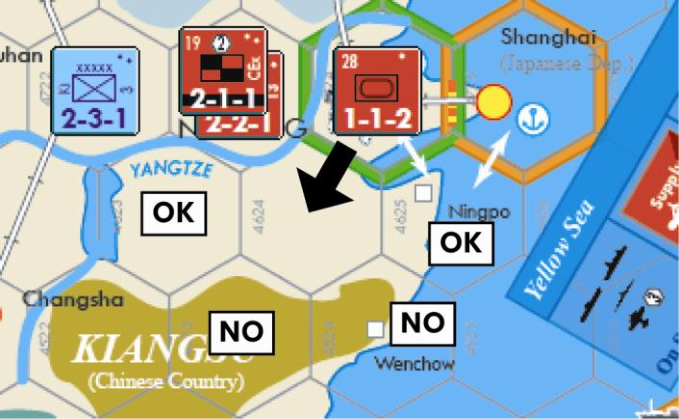
Example: A Japanese tank unit moves from Nanking (w4724) into the clear hex of w4624 (which costs 1 MP to enter). It cannot then move into Wenchow (w4524 – a rough hex), because its remaining MA is 1, and a rough hex costs 2 MP to enter.
Minimum Move Exception: A ground unit can exceed its MA when moving into the first hex it enters in a Movement Phase. If it does so, it must stop moving after entering that hex.
Clarification
Note that a unit may still be prohibited from moving into a hex due to other movement restrictions.
Example: The Japanese 2-1-1 HQ unit above moves from 24723 across the river hexside (+1 MP) into w4624 (1 MP). This is allowed even though the total 2 MP cost is above the HQ’s MA of 1.
Enemy Air Unit: Units can move out of a hex containing an enemy Air unit. This does not cost any additional MP.
Road or Rail: A unit that moves across a hexside along a Road or Rail (see Terrain Key) ignores any MP costs for the hex being entered and for any terrain along a hexside crossed by that Road or Rail. Instead, the unit pays a Road/Rail hexside MP cost based on whether it is a one-step or multi-step unit (see Terrain Key), and whether it is the Operational Movement Phase or Reserve Movement Phase. Crossing a Connected Strait uses Road/Rail MP costs.
Beachhead: If a ground unit starts a Movement Phase in any Land hex adjacent to an All-Sea hex containing a friendly Beachhead marker and it has not already moved in that Movement Phase, it can move into that hex. This move expends the unit’s entire MA.
Clarification
Units can cross All-Sea hexsides to enter a Beachhead hex. Friendly Beachheads act like “bridges” across All-Sea hexes.
If a ground unit starts a Movement Phase in a hex containing a friendly Beachhead marker and it has not already moved in that Movement Phase, it can move across the marker’s Beachhead Hexside only into an adjacent Land hex. This move expends the unit’s entire MA. A ground unit cannot move off a Beachhead marker through non-Beachhead Hexsides.
Clarification
Units cannot cross All-Sea hexsides to exit a Beachhead hex – they must exit through the Beachhead Hexside. While there are many ways into the Beachhead hex, there is only one way out.

Example: An Axis Beachhead is in hex w4119 in the South China Sea Naval Zone, facing Hanoi (w4219). The Japanese 3-3-1 15th Army starts the Operational Movement Phase in Haikou (w4120). The unit can move onto the Beachhead marker, but must stop moving. In a subsequent Movement Phase (such as the upcoming Reserve Movement Phase) it can move off that Beachhead to Hanoi. That ends its movement for the Phase. It could not move off the Beachhead marker back to Haikou.
Units may also exit Beachheads using Port-to-Port movement (3.1.2).
Marine Units: If a Marine unit starts a Movement Phase in a hex adjacent to an All-Sea hexside and it has not already moved in that Movement Phase, it can move across that All-Sea hexside into an adjacent Land hex. This move expends the unit’s entire MA.
Eastern Europe Box: If a Soviet ground unit starts a Movement Phase in any Land hex in Russia along the western edge of the map (from w5311 to w6011, inclusive) and it has not already moved in that Movement Phase, it may enter the Eastern Europe Box.
To do so, pick the unit up and place it in the Eastern Europe Box. This placement expends the unit’s entire MA.
If a Soviet ground unit starts a Movement Phase in the Eastern Europe Box, it may exit the Box to any Land hex in Russia along the western edge of the map (from w5311 to w6011, inclusive).
To do so, place the unit in any hex indicated above that does not contain an enemy Air unit (and in the Reserve Movement Phase, is not in an Enemy Zone of Control). This placement costs 1 MP. The unit is supplied, has its entire remaining MA, and can move immediately after placement using the Hex-to-Hex movement rules.
3.1.2 Port-to-Port Procedure
If a ground unit starts a Movement Phase in a hex with a Port or Beachhead marker, or in an Off-Map Box, and there is a friendly Troop Convoy marker with sufficient Transport Capacity (see below) in that Naval Zone’s Convoys Box, the unit can move across the Naval Zone to any other friendly Open Port in the Naval Zone.
To do so, pick the unit up and place it directly in the friendly Open Port.
Clarification
Although the port of embarkation does not have to be an Open Port, the port of debarkation does.
Example: British one-step infantry units are in Majuro (e3515) and Guadalcanal (e2611). A British Troop Convoy marker is in the Micronesia Naval Zone Box, which also contains a Japanese Air Force unit. There are Japanese Detachments in Kwajalein (e3513) and Truk (e3408), which makes them both Japanese Naval Bases. The British unit can move from Majuro and be placed in Guadalcanal as it is a Western Open Port in the Micronesia Naval Zone and is not within three hexes of a Japanese Naval Base. However, the reverse is not true – the British unit in Guadalcanal could not move to Majuro, because it is within three hexes of Kwajalein.
If the unit was moved to a Port in an Off-Map Box, the unit must stop moving.
If the unit was moved to a Multi-Zone Open Port hex, the unit can move again (in the same Movement Phase) across another Naval Zone to a friendly Open Port in an adjacent Naval Zone. A unit can continue such movement provided it adheres to all other movement restrictions (such as requiring a friendly Troop Convoy marker in the Naval Zone, or stopping after moving into an Off-Map Box).
Example: Continuing the example above, if there were a British Troop Convoy marker in the Coral Sea Convoys Box, the unit moving from Majuro could continue through the Multi-Zone Open Ports of Guadalcanal all the way to Townsville (e2106).
A unit that moves Port to Port across a Naval Zone expends its full MA, no matter how many Naval Zones it actually crosses in a single Movement Phase.
Transport Capacity: Each Escort, Scratch, or Standard Troop Convoy marker in a Convoys Box can transport one* one-step unit across its Naval Zone in a Movement Phase. After the Troop Convoy marker is used for transport, move it to that Naval Zone’s Used Box.
A US Fleet Train Troop Convoy marker in a Convoys Box can transport one unit of any size across its Naval Zone in a Movement Phase. After the Fleet Train marker is used for transport, move it to that Naval Zone’s Used Box.
Convoy markers cannot combine their capacity. Each marker is used separately.
Clarification
So you can’t use two Troop Convoys to transport a two-step unit. Only the Fleet Train can transport a multi-step unit! That’s what makes it so special.
△ Convoy Nationality: As specified below, the nationality of a Convoy marker limits who can use it to move Port-to-Port across a Naval Zone. Exception: Any Troop Convoy can transport any friendly Exp unit.
- Axis Scratch Convoy: any Axis unit
- British or US Convoy: any Western unit
- Japanese Convoy: a Japanese unit only
- Russian Convoy: a Russian unit only
- Soviet Scratch Convoy: any Soviet unit
- US Fleet Train Convoy: a US unit only
3.1.3 Off-Map Box to Off-Map Box
Procedure
An Allied ground unit can enter or exit an Off-Map Box directly from or to an adjacent Off-Map Box, as specified on the map. Unlike Port- to-Port movement, the unit must stop moving.
To do so, pick the unit up and place it in the other Off-Map Box. This move expends the unit’s entire MA.
There is no limit to the number of units that can move from Off-Map Box to Off-Map Box.
Units can enter an Off-Map Box in the same Movement Phase that other units exit, and vice versa.
Clarification
Moving Port-to-Port and Off-Map Box to Off-Map Box are separate from each other, so both can occur involving the same Off-Map Box in the same Movement Phase.
3.1.4 Movement Restrictions
Procedural Restriction:
- A ground unit cannot use different movement procedures in the same Movement Phase.
Clarification
So it is only one of Hex-to-Hex, Port-to-Port, or Off-Map Box to Off-Map Box.
Unit and Hex Restrictions:
- A ground unit cannot move into a hex containing an enemy unit. Exception: A multi-step armor-type unit conducting an Overrun (3.2) can move into a Land hex containing the one-step enemy ground unit it is overrunning.
- A ground unit cannot move into a hex containing an enemy Beachhead marker.
Weather Restrictions:
- A ground unit cannot move out of a hex affected by Mud (11.3) that contains an EZOC.
Clarification
There are no exceptions here – friendly units do not negate EZOC in mud.
- A ground unit must stop moving after it moves into or out of a hex affected by Storms (11.4) or Snow (11.5) that contains an EZOC.
Clarification
Again, friendly units do not negate EZOC here. However, a multi-step armor unit can ignore the EZOC of a unit is overrunning (3.2) in Storms or Snow.
Political Restrictions:
- Movement can be limited by Policies (13.6.1), Truces (13.6.2), and Failures rules (14.15).
- A ground unit cannot move into a hex outside its Home Country or Dependent during Pre-War (12.1).
- A ground unit cannot move into a hex in a Neutral Minor Country (13.4).
- △ If the Axis Quit India marker is in the Strategic Warfare Box, Western ground units in India or Ceylon cannot move into hexes outside of India or Ceylon.
- △ A non-Japanese Axis ground unit cannot move into a hex in an Axis Country or Dependent unless it is that unit’s Home Country or Dependent. Exception: Axis Exp units, regardless of nationality, can move into any Axis Country.
Clarification
Note that Exp units are always one-step units. Exp units lose their Exp ability when combined into a multi-step unit.
Axis multi-national units (13.8.3) are considered to be both Japanese and the nationality represented by the step in the unit’s Holding Box. That means, for example, if the Axis AEx HQ were composed of a Hopeh and Japanese step, it could enter Hopeh, but not Japan or an Axis Mongolia.
- △ An Axis Kwantung ground unit cannot move into a hex outside a Japanese Dependent unless Russia, Communist China, and Nationalist China are all not Policy Affected Countries (13.6.1). An Axis Kwantung ground unit can never move using the Port-to-Port Procedure.
Clarification
Unless Japan is fighting both Russia and China, this rule effectively limits Kwantung units to Manchukuo and Korea, along with Inner Mongolia or Soviet Far East Regions should those areas become Japanese Dependents.
Other Restrictions:
- A ground unit belonging to a Minor Country with a Free Passage (14.16), Mobilizing (14.32), or No Occupation (14.34) marker in its Capital cannot move into a hex outside that Minor Country or one of its Dependents.
- △ An Axis or Western ground unit cannot move into a hex in Russia along the western edge of the map, from w5311 to w6011 inclusive.
Design Note
This is to prevent the Axis faction from sealing off the map in order to prevent the Soviet faction from entering units from his Off-Map Box.
- A Soviet ground unit cannot move into a hex in an Axis Country or Dependent that was activated in the just completed Western War & Peace Segment (6.1).
Design Note
This is to prevent the Allied factions from taking advantage of the order of the Turn Sequence.
- © An Allied ground unit cannot move into an Off-Map Box on the TK map.
© Design Note
The TK and DS maps are “closed” in the sense that it’s not possible to move units directly from one map to the other. The Allies do have the ability to transfer support units between the Force Pools of the two maps using Pacific Commitment Political Events (15.14.2), and through card play they can influence the number of replacement steps received on each map. But once a ground unit is on a map, it’s committed to that theater.
3.2 Overruns
If using the Hex-to-Hex procedure and not otherwise prohibited, a multi-step armor-type unit can move into a Land hex containing only a single, one-step enemy ground unit.
Clarification
So if the hex has more than one enemy one-step ground unit or a multi-step unit in it, you can’t overrun that hex. Markers have no effect on overruns.
The moving unit only pays the normal MP costs to move into the hex. An overrun does not cost any additional MP.
The moving unit can ignore the EZOC of the unit it will overrun, provided the moving unit immediately moves into the hex with the enemy unit after entering that EZOC hex.
The moving unit cannot ignore the EZOC of other units, unless another friendly unit is in that hex.
Immediately after moving into the hex, the enemy unit is eliminated. Place it in the Delay Box if it has a Delay Stripe. Otherwise, place it in its Force Pool.
The same multi-step unit can make more than one overrun in the same Movement Phase.
An overrun is allowed in hexes affected by Storms and Snow.
Overrun Restrictions: Overruns cannot be conducted:
- in the Reserve Movement Phase (5).
- when conducting Exploitation.
- if the enemy one-step unit could receive a defender’s CRT Column Shift (as if a combat were fought there) due to Terrain, Mud, Fortress, Air, or HQ. The same HQ can prevent more than one overrun for the same or different defenders in the same Movement Phase.
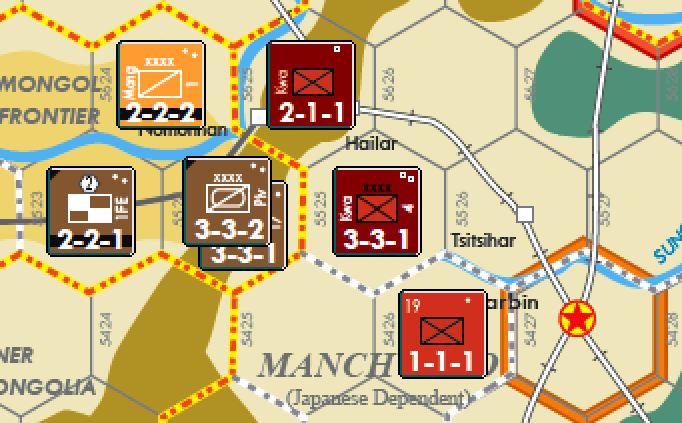
Example: The Russian Plv cav-mech army in w5525 cannot overrun the 2-1-1 Kwantung infantry unit in Hailar (w5625) because it is a rough terrain hex, which would provide the defender a CRT column combat shift.
The Plv cav-mech army also cannot overrun the 4th Kwantung Army in w5525 because it is a multi-step unit.
The Japanese 1-1-1 infantry unit w5426 is a viable target because it is a one-step unit without a CRT column combat shift, but the Plv cav- mech army can’t move into w5425 and then overrun because there is more than one EZOC in the w5425 hex. (It can ignore the EZOC from the 1-1-1 infantry unit, but not the EZOC from the 4th Kwantung Army.)
So the Soviet player does the following: First, he moves a 3-3-1 infantry unit from w5525 to w5425. It must now stop because of the EZOC from the Japanese units. This infantry unit now negates all EZOC in the w5425 hex.
Then the Plv cav-mech army moves from w5525 into w5425 and w5426, overrunning the Japanese infantry unit. The Japanese line has been outflanked!
How could the Japanese have prevented this disaster? If there had been a Japanese HQ unit in Harbin (w5427), then no overrun against any of the Japanese units could have occurred because the supplied Japanese HQ could have provided any of the defenders a CRT column combat shift.