
Game Components
A complete copy of TK includes these components:
- This Rulebook
- A Scenario Book
- Two 22 × 34 inch maps
- Three countersheets each with 280 counters (840 total)
- Three decks of option cards (one for each faction – the Axis deck has 76 cards, the Western deck has 59 cards, and the Soviet deck has 65 cards)
- Three Force Pool Displays (one for each faction)
- Three Player Aid Cards (one for each faction)
- One Support Unit & Convoy Marker Aid Card
- One Scenario Display Card for the one-map campaign scenarios
- One six-sided die
Game Scale
△ A hex on the map is about 60 miles across. Off-Map Boxes represent areas Axis forces had no true capability of conquering.
A Turn represents from 30 to 60 days.
Each year consists of four seasons:
- Spring begins with the Mar-Apr turn.
- Summer begins with the May-June turn.
- Autumn begins with the Aug-Sept turn.
- Winter begins with the Nov-Dec turn.
Counters (Units, Markers)
There are two types of counters: units and markers. Any counter that is not a ground unit or support unit is a marker.
Ground units: These units represent combat formations from battalions to armies. Ground units (and only ground units) always have these three numbers printed along the bottom of their counter: Attack Factor, Defense Factor, and Movement Allowance.
Clarification
Other counters may be considered “units,” but only the ones with three numbers on the bottom are ground units.
Ground units may also have this information:
- Step Value indicates the number of steps in a unit. The number of steps in a unit is shown as one, two, or three dots or squares printed in the upper-right corner of the counter.
Clarification
Most ground units use dots to indicate their Step Value. Garrison and fortress units use squares to indicate they are limited in their ability to organize or break down during the Organization Segment (2.3).
- Organization Size “xxxx” indicates an army. All armies are multi-step units.
- Historical ID (located to the right of the unit-type symbol box) is a unit’s historical identity.
- Nationality ID (located to the left of the unit-type symbol box) indicates which Minor Country <mark class=“red”or Faction the counter belongs to.
Clarification
Major Country units do not have Nationality IDs on them, except for German SS units.
Unit-Type Symbol indicates the unit type. There are four ground unit types:
- △ Infantry units have an infantry, garrison, mountain, ski, cavalry, airborne, or marine symbol.

- Armor units have armor, mechanized, cav-mech, or helicopter symbols. Armor is sometimes referred to as panzer or tank, but there is no difference in game play.

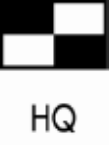
- HQ Units have an HQ Symbol
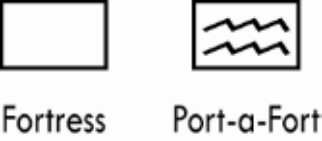
- Fortress units have an empty box or trench lines symbol. Those with trench lines are referred to as Port-a-Fort units.
Clarification
Note that the unit-type symbol is what matters when determining a unit type, and not the individual unit components. Thus, a three-step Western HQ unit is not an armor-type unit, even though an armor-type unit was used to form it.
- Unit-Type Symbol Color indicates a “special” unit type. Not all unit-type symbols are colored; those units are normal units.

Support units: These units represent concentrations of air and naval activity. There are two categories of support units, Air and Fleet. They are further broken down into several different types:
- Air Force units have an aircraft icon. All Air Force units have Escort Troop Convoy markers on their backs.
- Bomber units have a bomber aircraft icon, down-arrow symbol (indicating they cannot contest support unit placement), and DRM symbol. All Bomber units have Devastation markers on their backs.
- CV Strike units have an aircraft icon. A CV Strike unit has its CV Fleet unit on the front.
- Interceptor units have an aircraft icon and up-arrow symbol (indicating they can only contest support unit placement).
- CV Fleet units have a carrier ship icon. A CV Fleet unit has its CV Strike unit on the back.
- Surface Fleet units have a battleship icon. All Surface Fleet units have Escort Troop Convoy markers on their backs.
- Sub Fleet units have a submarine icon, down-arrow symbol (indicating they cannot contest support unit placement), and DRM symbol.
Markers: These counters are used to mark various game functions. Here are some of the important ones you’ll encounter:
Airdrop markers have a parachute symbol. All Airdrop markers are found on the backs of their parent airborne and helicopter ground units.
Beachhead markers represent invasion beachheads and temporary ports. These markers have arrow, port, aircraft, and Limited Stacking icons on the front. They have arrow, port, and battleship icons on the back.
Convoy markers represent merchant marine activity. These markers have a transport ship icon. They may read Supply on one side and Troop on the other. There are four types of Convoy markers: Standard Convoy markers, Axis and Soviet Scratch Convoy markers, the US Fleet Train Convoy marker, and Escort Troop Convoy markers (found on the backs of Air Force and Surface Fleet support units).
ClarificationStandard Convoy markers do not have a Delay Stripe. The three other types of Convoy markers do.
When the rules refer to “a Troop Convoy marker,” they mean any such Convoy marker. When they refer to “a Supply Convoy marker,” they likewise mean any such marker – including the inherent Western Supply Convoy markers found in a number of Naval Zones.
Detachment markers represent small garrisons to keep supply lines open and port facilities operational. They have a pennant flag symbol. All Detachment markers are found on the backs of certain infantry ground units.
Other Counter Information: Both units and markers may contain these additional bits of information:
Delay Stripe indicates the counter must be placed in a Delay Box when it is removed from the map.
Range is the maximum distance in hexes that an Air unit or A-bomb marker can be placed from an Air Base. For HQ units, it is the maximum distance the HQ can provide Ranged Support. For Airdrop markers, it is the maximum distance in hexes the marker may be placed from its parent airborne or helicopter unit. For Failure and Blitz markers, it is their radius of effect.
Reinforcement Letter, Number, or Asterisk. If this is a number, it matches the option card that brings this counter into play. This will help you find the counters faster while playing.
If this is a letter, it matches a Political or Conditional Event that brings the counter into play. Here’s what some of those mean:
Clarification
The “N” stands for a “new” Minor Country
- △ P : the counter is brought into play with a faction’s Partnership option card.
- Ⓡ: the counter is a variant counter not used in standard play.
Clarification
The Ⓡ stands for “Random Campaign Game.” You can set aside all Ⓡ counters for now. The rules for these counters are included in the Axis Empires Expansion Kit, which will be available separately. We’ve included them here to give you a taste of some of the cool things you’ll find in the Kit, and also to make the most efficient use of available space.
- △ V : the counter may enter play after Vichy is created (13.8.6).
If this is an asterisk, it means this counter is not used in the AE combined game.
Option Cards
There are three sets of option cards included with the game – one set each for the Axis, Soviet, and Western factions.
Each card has a color that indicates its War State. Blue cards are Pre-War cards. Gray cards are Limited War cards. Magenta cards are Total War cards. A card’s War State is also indicated by text in the upper right corner.
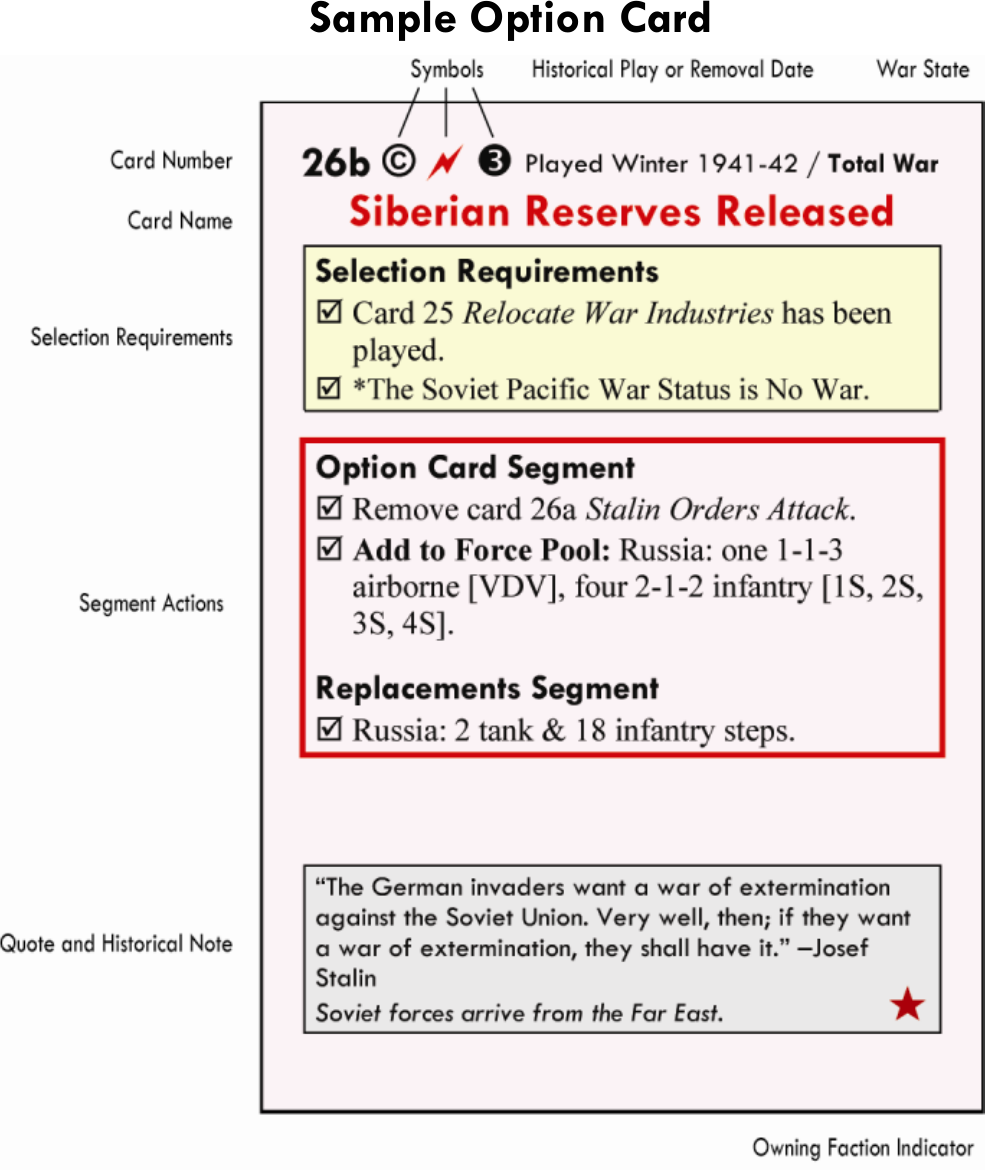
Cards may have the following information:
Card Number matches the Reinforcement Number printed on counters. Not all cards have a unique number. Some numbers may be duplicated and have a letter added to them. Card numbers that appear in red are used in one-map scenarios only.
Symbols identify those cards with special properties; not all cards have these marks.
- A lightning bolt (🗲) symbol indicates a Blitz card. A Blitz card’s Blitz Value is determined by counting the number of lightning bolts on the card.
- A hammer-and-wrench (🛠) symbol indicates the card is a Rearmament card.
- A set of circular arrows (♺) indicates the card is a recyclable card.
- On Soviet cards only, a number in a black circle indicates the card’s Production Value (©1.1.3.3).
- A © symbol indicates the Card has a counterpart in the DS deck that must be paid attention to in AE.
Card Name indicates its name. Not all cards have unique names.
Selection Requirements lists the conditions that must be in effect to select the card as a Pending Card (1.1.3).
Segment Actions indicate actions that must be performed during certain Segments of the Turn, such as the Option Card Segment or Conditional Events Segment. Events that are surrounded by a red border are performed in Seasonal Turns only. Events that are not surrounded by a red border are performed each Turn.
Quote and Historical Note provided for historical flavor only.
Owning Faction Indicator identifies which of the three factions owns the card.
Historical Play or Removal Date indicates when the card was played or removed from the deck historically. (Exception: some Axis cards use this area to indicate they are only used for one-map scenarios.)
Clarification
Players do not have to play cards in historical order – but doing that the first time you play TK isn’t a bad idea, just to see what’s going on.